

Short answer: reinforced polyamide can be a strong choice for cameras exposed to salt, moisture or selected chemicals because the polymer body itself does not corrode like bare metal. It is not automatically the best material for every harsh site. The right choice depends on the complete exposure profile, documented ratings, chemical compatibility, temperature, UV, impact risk and every exposed part—from the bracket and fasteners to the cable gland.
This is therefore not a simple “polymer beats metal” comparison. A coastal loading dock, a food-processing washdown line and a chemical storage area can all be described as corrosive, yet they create different failure mechanisms. Start with the environment, then select a camera and mounting system whose exact documentation addresses that environment.
1. Build an exposure dossier before choosing a housing
“Outdoor” is not a useful corrosion specification. Record the agents and operating conditions that the installed assembly will actually face. The following five questions turn a vague harsh-environment request into a material-selection brief.
- What reaches the equipment? Identify salt spray, airborne chlorides, acidic or alkaline vapors, fertilizers, oils, disinfectants, cleaning foam or other agents by name.
- At what concentration and frequency? Occasional sea air is not the same exposure as direct splash; periodic washdown is not the same as continuous immersion.
- What are the temperature and UV conditions? Heat, cold, solar radiation and rapid thermal cycling can affect plastics, coatings and seals differently.
- How will the equipment be cleaned? Record chemical, concentration, water pressure, nozzle distance and temperature. A camera that resists ambient exposure may not tolerate a specific sanitation process.
- What mechanical loads exist? Consider impact, vibration, wind loading, ice, moving machinery and the safe load of the mounting surface.
2. Map the complete corrosion failure path
The enclosure body is only one link in the chain. A non-rusting shell does not protect a weak bracket, damaged connector or incompatible gasket. Review the exposed assembly as six connected zones.
| Zone | Typical failure path | Evidence to request |
|---|---|---|
| Camera body | Metal oxidation, coating damage, chemical attack or UV aging | Exact housing material, surface treatment and relevant environmental test information |
| Window or dome | Etching, clouding, scratching or cleaning residue that reduces image quality | Window material, approved cleaning method and replacement procedure |
| Seals and glands | Swelling, cracking, loss of compression or incorrect installation | Seal material, cable-diameter range, torque and re-entry instructions |
| Fasteners | Galvanic interaction, seized threads or rust staining | Fastener grade, isolating washers and approved assembly practice |
| Bracket and pole | Coating damage at drilled holes, edges or interfaces | Bracket material, finish, load rating and field-repair method |
| Cable and connector | Moisture tracking, capillary ingress or exposed copper | Outdoor cable rating, connector enclosure and drip-loop detail |
This whole-system view also prevents a common procurement mistake: pairing an anti-corrosion camera with a standard indoor junction box or untreated mounting hardware. The weakest exposed part may determine service life.
3. Compare the material approaches by failure mode
| Housing approach | Where it can help | What still needs verification |
|---|---|---|
| Reinforced polyamide | The body does not rust like steel; lower enclosure mass may simplify some mounting work | Polymer formulation, UV and temperature limits, chemical compatibility, flame requirements, impact rating and the material of every accessory |
| Coated aluminum or steel | Broad model choice, familiar mechanical behavior and established mounting ecosystems | Coating system, edge and thread protection, damage repair, substrate exposure and maintenance interval |
| Stainless steel | A durable metal solution for many industrial applications when the alloy and fabrication suit the environment | Stainless grade, crevice and chloride conditions, weld treatment, surface finish, dissimilar metals, weight and installation handling |
There is no universal ranking. Polymer may reduce one corrosion mechanism while introducing project-specific questions about UV, heat or chemical exposure. Stainless steel may be appropriate in one chemical process but unsuitable or unnecessarily heavy in another. Coated metal can perform well when the coating remains intact and the maintenance plan is realistic.
Do not convert those general tendencies into unsupported service-life or cost-saving claims. Installation labor, supporting steelwork, access equipment, replacement intervals and cleaning practices all influence lifecycle cost. Compare those items using the actual site design and supplier documentation.
4. Ratings decoder: four labels that answer different questions
- IP rating
- Addresses protection against solid-particle and water ingress under defined test conditions. It does not, by itself, establish long-term salt or chemical resistance.
- IK rating
- Addresses resistance to external mechanical impact. It is not a corrosion rating.
- NEMA 4X
- Applies to an enclosure type with additional corrosion-related provisions alongside protection from environmental conditions. Check the named model and the referenced standard rather than treating “4X” as a general material label.
- C5
- Signals a very-high corrosivity category in the cited coating or corrosion framework, but the relevant test, duration, system boundary and product documentation still matter.
These classifications are complementary, not interchangeable. A useful shortlist states exactly which model carries which rating and links to the current data sheet. It should also state what has not been proven—for example, compatibility with a buyer's washdown chemical.
5. Use exact models to test the brief
The examples below show why buyers should compare documented model properties rather than transfer one product's claims to an entire family. They are starting points for technical review, not a declaration that any model is suitable for every corrosive site.
| Model | Documented selection signals | Good next question |
|---|---|---|
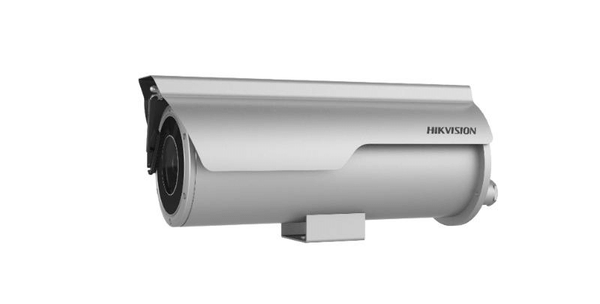
| Hikvision DS-2XC6027G0-L(S) (PA) | Fixed-bullet polymer anti-corrosion camera; the listed model information identifies IP68, NEMA 4X and C5 | Does the documented PA/GF body-and-bracket assembly match the site's chemical, UV and cleaning profile? |
| Hikvision DS-2XC3146G0H-LISU/SL (PA) | Fixed-dome polymer anti-corrosion design with IP68 and IK10 listed for the model | Are the dome, strobe/audio functions and motorized adjustment appropriate for the exact scene and local policy? |
| Hikvision DS-2DT8C442MXG-LWT | 42× polymer anti-corrosion speed dome; the listed model information identifies IP67, NEMA 4X and C5 | Can the supporting structure, power design and maintenance access safely accommodate the PTZ assembly? |
For a source outside the seller page, review the manufacturer's current DS-2XC6027G0-L(S) (PA) data sheet. Hikvision also groups project-oriented explosion-proof and anti-corrosion products in its project product guide. Always confirm document revision, regional variant and order code before purchasing.
6. Turn the analysis into a procurement brief
A strong request for quotation should make every critical assumption visible. Copy the following fields into the project schedule and require the supplier or engineer to answer at model level.
- Location: indoor, sheltered outdoor, direct weather, splash zone or another defined exposure.
- Corrosive agents: named chemicals or salts, concentration, contact frequency and duration.
- Cleaning: product, dilution, pressure, temperature, nozzle distance and cleaning interval.
- Climate: operating temperature, humidity, condensation, UV and thermal cycling.
- Mechanical conditions: vibration, impact risk, wind, ice and support-load limit.
- Complete material schedule: housing, window, bracket, fasteners, seals, gland, junction box and cable.
- Documented ratings: exact-model IP, IK, corrosion classification and any separately required hazardous-area approval.
- Installation controls: torque, sealing, drip loops, isolation between dissimilar metals and treatment of drilled or cut surfaces.
- Acceptance evidence: daylight and night image checks, PTZ movement where relevant, audio/strobe policy checks and inspection photos of every sealed interface.
7. Plan inspection around likely weak points
Maintenance should follow the failure-path map. Establish a clean baseline at commissioning, then inspect more frequently during the first exposure cycle. Look for coating blisters, rust staining, chalking, cracking, loose glands, damaged seals, clouded windows, water traces and movement at the bracket. Record findings with consistent photographs so change can be compared over time.
After cleaning, storms, chemical releases or maintenance that opens a cable entry, repeat the relevant checks. Replace damaged seals and repair approved coatings according to the equipment instructions; do not improvise with sealants that may attack the enclosure material or prevent correct servicing.
Selection takeaway
Polyamide can remove the risk of rusting at the main camera body and may support a lighter assembly, but material name alone cannot guarantee durability. The defensible route is to document the exposure, compare complete assemblies, separate ingress and impact ratings from corrosion evidence, and verify every claim against the exact SKU. That process makes the choice between polymer, coated metal and stainless steel both safer and easier to audit.